How to make iced coffee: the ultimate 2026 guide How to make iced coffee: the ultimate 2026 guide Recipes
Recipes

How to make iced coffee: the ultimate 2026 guide

Will

Written by Will / Views

Published - 01 July 2025 / Updated - 19 May 2026

Key takeaways

  • The secret to great iced coffee at home is concentration – brew stronger than usual so the drink holds its character as the ice melts.
  • Coffee ice cubes are the simplest upgrade you can make: freeze leftover coffee from your morning brew and use them instead of water ice to keep the flavour bold to the last sip.
  • There are three methods worth knowing: classic iced coffee with milk, Japanese flash chill for black coffee lovers, and cold brew for a slow-steeped, low-acidity alternative.
  • Light and medium roasts shine in the Japanese flash chill method. A medium or dark Brazilian roast works beautifully in a classic iced coffee with milk.
  • Cold brew is made without heat (time does the work instead) and produces a naturally sweet, smooth cup with almost no bitterness.

When the sun finally arrives in the UK, a steaming cup isn’t always what you’re after. But there’s no reason to give up on great coffee just because you want it cold.

The problem is, a lot of homemade iced coffee ends up watery, bitter, or flat – and the reason’s almost always the same. Melting ice dilutes the coffee, washing out the. The fix is simpler than it sounds, and once you understand it, making genuinely good iced coffee at home becomes second nature.

This guide covers three methods, from the quickest and most accessible to the most rewarding – so you can find the one that suits how you drink.

What is the secret to making great iced coffee at home?

Dilution is the main challenge. As ice melts, it introduces extra water into the cup, gradually drowning out the complexity of a well-grown speciality bean – the brightness, the sweetness, the distinct character of the origin.

The solution is concentration. When learning how to make iced coffee at home, start with a stronger base than you’d normally brew – either by using more coffee grounds, less water, or both. That way, as the ice does its work, the drink retains its strength and character rather than fading into something bland.

The other key is speed. Cooling your coffee quickly, a technique known as flash chilling, traps the volatile aromatic oils in the liquid before they have a chance to oxidise and flatten. Hot coffee left to cool slowly on a worktop loses flavour as it sits. Hot coffee poured directly over ice locks it in.

One more tip before you start: freeze leftover coffee from your morning brew in an ice cube tray. Coffee ice cubes melt into the drink rather than diluting it. This is a small change that makes a noticeable difference right through to the final sip.

Pouring milk into iced coffee

How to make iced coffee

This is the quickest route to a cold coffee on a warm day – rich, creamy, and satisfying in the way that a well-made iced latte always is.

You will need:

  • A double espresso – or a short, strong coffee.
  • Your choice of milk.
  • Ice.

If you don’t have an espresso machine, you can find out how to make a short, strong coffee with a wide range of brewing methods in our blog article here

Method:

  • Brew a double espresso (or strong coffee of your choice). 
  • Pour the coffee over half a glass of ice (expert tip: use ice made from frozen coffee to prevent your drink being too diluted). 
  • Top up with milk and stir. 
  • Enjoy your iced coffee.
Japanese flash chilling coffee

How to make Japanese flash chill iced coffee

If you prefer your coffee black and want to taste the full character of what’s in the bag, the sparkling acidity, the fruit notes, the clarity that a well-processed high-altitude bean can produce – the Japanese flash chill method is worth learning.

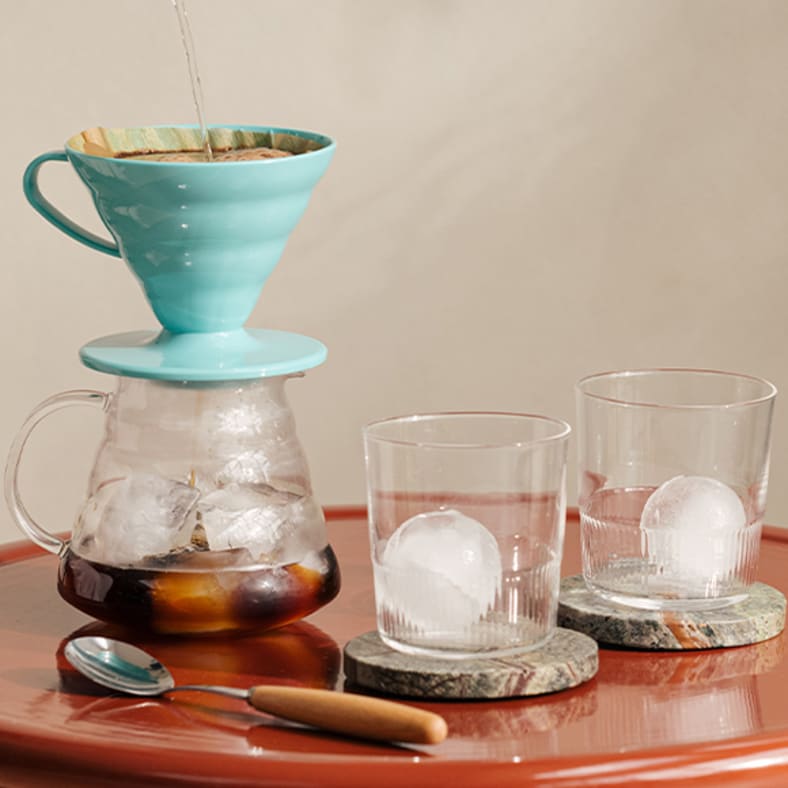
The principle is simple: instead of brewing hot coffee and then chilling it down, you brew directly over ice. The extraction happens in the usual way, but the coffee chills the instant it lands, capturing the aromatic compounds before they can escape.

You will need:

  • Hario V60
  • Hario V60 filter
  • 30g medium-grind coffee
  • Ice

Method:

  • Fill a glass with ice cubes. 
  • Put your V60 and V60 filter on top of the glass.
  • Add 30g medium-grind coffee to your V60. 
  • Pour just off boiling water over your coffee slowly, in overlapping circles. 
  • Repeat until your glass is full with iced coffee.

Find our quick video tutorial here.

quotes
The Japanese flash chill is the best method for making iced coffee. As the ice melts in the glass, it dilutes the coffee, so you want to double the amount of ground coffee you’re using to get that strength of flavour.
Will Corby, Pact’s Director of Coffee, who has 21 years experience in speciality coffee.

Light and medium roasts are the best choice for this method – they hold onto the bright, vivid acidity that flash chilling captures so well.

A single-origin Rwandan or Kenyan, brewed this way, brings fascinating black-fruit flavours.

Pouring cold brew coffee

How to make cold brew coffee

Cold brew is a different thing entirely– not iced coffee in the conventional sense, but a slow, low-temperature extraction that produces a cup unlike anything made with hot water.

Where flash chilling relies on heat and speed, cold brew uses time instead of temperature. Grounds steep in cold water for an extended period (usually 12 to 24 hours) drawing out the sweeter, heavier compounds in the bean while leaving behind much of the brighter acidity. 

The result is a smooth, naturally sweet, syrupy coffee with almost no perceived bitterness.

To find out how to make the perfect cold brew coffee at home, including brew ratios and steeping times, head to our dedicated brew guide

If you’re wondering what the difference is between cold brew and iced coffee, we’ve got the full answer on our cold brew vs iced coffee blog post.

Which cold coffee is right for you?

Choose classic iced coffee if you love a rich, creamy drink and want something refreshing and satisfying with milk. It works with almost any brewing equipment and is an excellent showcase for medium and dark Brazilian and Colombian roasts.

Choose Japanese flash chill if you drink your coffee black and want to taste the distinct character of the bean – the jasmine, bergamot, or bright red berry notes that high-altitude African coffees are known for. It takes a little more attention, but the clarity in the cup is remarkable.

Choose cold brew if you prefer a heavier, smoother, lower-acidity drink and don’t mind planning ahead. Because cold water doesn’t extract the lighter, brighter acids from the bean, cold brew is naturally mellow and sweet, and it keeps in the fridge for up to a week, which makes it a practical option for warm spells when you want something cold ready to go.

FAQs

How do I make iced coffee without a machine? 

Making iced coffee without a machine is straightforward. Use a cafetière or an AeroPress to brew a short, concentrated coffee with roughly half your usual amount of water. Once brewed, pour it directly over a glass of ice to chill it instantly, then add milk if you like. The concentration compensates for the dilution from the ice, keeping the flavour bold and clear.

How do I make iced coffee at home without it tasting watery? 

The key is to brew stronger than usual – either by using more coffee grounds, less water, or both. Pouring the hot concentrate directly over ice rather than leaving it to cool slowly also helps, as flash chilling locks in the aromatic oils before they can oxidise. Coffee ice cubes are worth making too: freeze leftover brewed coffee and use those in place of water ice so the drink stays full-flavoured to the last sip.

Can I store iced coffee in the fridge overnight? 

Cold brew keeps well in the fridge for up to a week and is well suited to making in batches. Hot-brewed iced coffee, however, is best made fresh. Once brewed coffee sits (even chilled!) it continues to oxidise, turning flat and woody over time. For the best results, flash chill it and drink it the same day.

Which roast works best for iced coffee?

It depends on the method. Light and medium roasts are the natural choice for Japanese flash chill – their bright, sparkling acidity comes through beautifully when captured quickly over ice. For classic iced coffee with milk, a medium or dark roast from Brazil works well, providing the chocolatey, rounded base that holds up against milk and ice. For cold brew, a medium roast tends to produce the most balanced result.

What is the difference between cold brew and iced coffee? 

Iced coffee is hot-brewed coffee that’s chilled, either by flash chilling over ice or by cooling it down after brewing. Cold brew is made without heat at all – grounds steep in cold water for 12 to 24 hours, producing a smoother, lower-acid, naturally sweet concentrate. The two taste quite different: iced coffee retains the brightness and complexity of a hot brew, while cold brew is heavier, mellower, and more syrupy.

Want your coffee roasted fresh and delivered to your door? Explore Pact’s range of 84+ point speciality coffees at pactcoffee.com – perfect for your iced coffee base, whatever method you use.

Need it today? Find our fresh coffee beans in the coffee aisle at Waitrose.

How to make iced coffee: the ultimate 2026 guide

Will

Written by Will

Views

Published - 01 July 2025

Updated - 19 May 2026

Key takeaways

  • The secret to great iced coffee at home is concentration – brew stronger than usual so the drink holds its character as the ice melts.
  • Coffee ice cubes are the simplest upgrade you can make: freeze leftover coffee from your morning brew and use them instead of water ice to keep the flavour bold to the last sip.
  • There are three methods worth knowing: classic iced coffee with milk, Japanese flash chill for black coffee lovers, and cold brew for a slow-steeped, low-acidity alternative.
  • Light and medium roasts shine in the Japanese flash chill method. A medium or dark Brazilian roast works beautifully in a classic iced coffee with milk.
  • Cold brew is made without heat (time does the work instead) and produces a naturally sweet, smooth cup with almost no bitterness.

When the sun finally arrives in the UK, a steaming cup isn’t always what you’re after. But there’s no reason to give up on great coffee just because you want it cold.

The problem is, a lot of homemade iced coffee ends up watery, bitter, or flat – and the reason’s almost always the same. Melting ice dilutes the coffee, washing out the. The fix is simpler than it sounds, and once you understand it, making genuinely good iced coffee at home becomes second nature.

This guide covers three methods, from the quickest and most accessible to the most rewarding – so you can find the one that suits how you drink.

What is the secret to making great iced coffee at home?

Dilution is the main challenge. As ice melts, it introduces extra water into the cup, gradually drowning out the complexity of a well-grown speciality bean – the brightness, the sweetness, the distinct character of the origin.

The solution is concentration. When learning how to make iced coffee at home, start with a stronger base than you’d normally brew – either by using more coffee grounds, less water, or both. That way, as the ice does its work, the drink retains its strength and character rather than fading into something bland.

The other key is speed. Cooling your coffee quickly, a technique known as flash chilling, traps the volatile aromatic oils in the liquid before they have a chance to oxidise and flatten. Hot coffee left to cool slowly on a worktop loses flavour as it sits. Hot coffee poured directly over ice locks it in.

One more tip before you start: freeze leftover coffee from your morning brew in an ice cube tray. Coffee ice cubes melt into the drink rather than diluting it. This is a small change that makes a noticeable difference right through to the final sip.

Pouring milk into iced coffee

How to make iced coffee

This is the quickest route to a cold coffee on a warm day – rich, creamy, and satisfying in the way that a well-made iced latte always is.

You will need:

  • A double espresso – or a short, strong coffee.
  • Your choice of milk.
  • Ice.

If you don’t have an espresso machine, you can find out how to make a short, strong coffee with a wide range of brewing methods in our blog article here

Method:

  • Brew a double espresso (or strong coffee of your choice). 
  • Pour the coffee over half a glass of ice (expert tip: use ice made from frozen coffee to prevent your drink being too diluted). 
  • Top up with milk and stir. 
  • Enjoy your iced coffee.
Japanese flash chilling coffee

How to make Japanese flash chill iced coffee

If you prefer your coffee black and want to taste the full character of what’s in the bag, the sparkling acidity, the fruit notes, the clarity that a well-processed high-altitude bean can produce – the Japanese flash chill method is worth learning.

The principle is simple: instead of brewing hot coffee and then chilling it down, you brew directly over ice. The extraction happens in the usual way, but the coffee chills the instant it lands, capturing the aromatic compounds before they can escape.

You will need:

  • Hario V60
  • Hario V60 filter
  • 30g medium-grind coffee
  • Ice

Method:

  • Fill a glass with ice cubes. 
  • Put your V60 and V60 filter on top of the glass.
  • Add 30g medium-grind coffee to your V60. 
  • Pour just off boiling water over your coffee slowly, in overlapping circles. 
  • Repeat until your glass is full with iced coffee.

Find our quick video tutorial here.

quotes
The Japanese flash chill is the best method for making iced coffee. As the ice melts in the glass, it dilutes the coffee, so you want to double the amount of ground coffee you’re using to get that strength of flavour.
Will Corby, Pact’s Director of Coffee, who has 21 years experience in speciality coffee.

Light and medium roasts are the best choice for this method – they hold onto the bright, vivid acidity that flash chilling captures so well.

A single-origin Rwandan or Kenyan, brewed this way, brings fascinating black-fruit flavours.

Pouring cold brew coffee

How to make cold brew coffee

Cold brew is a different thing entirely– not iced coffee in the conventional sense, but a slow, low-temperature extraction that produces a cup unlike anything made with hot water.

Where flash chilling relies on heat and speed, cold brew uses time instead of temperature. Grounds steep in cold water for an extended period (usually 12 to 24 hours) drawing out the sweeter, heavier compounds in the bean while leaving behind much of the brighter acidity. 

The result is a smooth, naturally sweet, syrupy coffee with almost no perceived bitterness.

To find out how to make the perfect cold brew coffee at home, including brew ratios and steeping times, head to our dedicated brew guide

If you’re wondering what the difference is between cold brew and iced coffee, we’ve got the full answer on our cold brew vs iced coffee blog post.

Which cold coffee is right for you?

Choose classic iced coffee if you love a rich, creamy drink and want something refreshing and satisfying with milk. It works with almost any brewing equipment and is an excellent showcase for medium and dark Brazilian and Colombian roasts.

Choose Japanese flash chill if you drink your coffee black and want to taste the distinct character of the bean – the jasmine, bergamot, or bright red berry notes that high-altitude African coffees are known for. It takes a little more attention, but the clarity in the cup is remarkable.

Choose cold brew if you prefer a heavier, smoother, lower-acidity drink and don’t mind planning ahead. Because cold water doesn’t extract the lighter, brighter acids from the bean, cold brew is naturally mellow and sweet, and it keeps in the fridge for up to a week, which makes it a practical option for warm spells when you want something cold ready to go.

FAQs

How do I make iced coffee without a machine? 

Making iced coffee without a machine is straightforward. Use a cafetière or an AeroPress to brew a short, concentrated coffee with roughly half your usual amount of water. Once brewed, pour it directly over a glass of ice to chill it instantly, then add milk if you like. The concentration compensates for the dilution from the ice, keeping the flavour bold and clear.

How do I make iced coffee at home without it tasting watery? 

The key is to brew stronger than usual – either by using more coffee grounds, less water, or both. Pouring the hot concentrate directly over ice rather than leaving it to cool slowly also helps, as flash chilling locks in the aromatic oils before they can oxidise. Coffee ice cubes are worth making too: freeze leftover brewed coffee and use those in place of water ice so the drink stays full-flavoured to the last sip.

Can I store iced coffee in the fridge overnight? 

Cold brew keeps well in the fridge for up to a week and is well suited to making in batches. Hot-brewed iced coffee, however, is best made fresh. Once brewed coffee sits (even chilled!) it continues to oxidise, turning flat and woody over time. For the best results, flash chill it and drink it the same day.

Which roast works best for iced coffee?

It depends on the method. Light and medium roasts are the natural choice for Japanese flash chill – their bright, sparkling acidity comes through beautifully when captured quickly over ice. For classic iced coffee with milk, a medium or dark roast from Brazil works well, providing the chocolatey, rounded base that holds up against milk and ice. For cold brew, a medium roast tends to produce the most balanced result.

What is the difference between cold brew and iced coffee? 

Iced coffee is hot-brewed coffee that’s chilled, either by flash chilling over ice or by cooling it down after brewing. Cold brew is made without heat at all – grounds steep in cold water for 12 to 24 hours, producing a smoother, lower-acid, naturally sweet concentrate. The two taste quite different: iced coffee retains the brightness and complexity of a hot brew, while cold brew is heavier, mellower, and more syrupy.

Want your coffee roasted fresh and delivered to your door? Explore Pact’s range of 84+ point speciality coffees at pactcoffee.com – perfect for your iced coffee base, whatever method you use.

Need it today? Find our fresh coffee beans in the coffee aisle at Waitrose.